Why No Two Artreestry Pieces Look Identical — And Why That's the Point
Every Artreestry piece is made from natural stone. And natural stone is not a controlled material — it is a geological record, formed over millions of years under specific pressures, temperatures, and mineral conditions that never repeat in exactly the same way. The piece you receive will not look identical to the one in the product photograph. This is not a flaw. It is the defining characteristic of the material — and the reason it is worth having.
What Creates the Variation
Marble and onyx get their colour and veining from mineral impurities introduced during the stone's formation. Iron oxides create red, yellow, and brown tones. Chlorite creates green. Carbon creates black and grey. The veining patterns — the white streaks through black marble, the grey wisps through white Carrara, the swirling white lines through green onyx — are the traces of recrystallised minerals that moved through the parent rock under heat and pressure.
No two sections of stone experienced exactly the same mineral exposure, pressure, or temperature during formation. This means that even two pieces cut from adjacent sections of the same slab will differ in their veining pattern, colour intensity, and surface character. At scale — across an entire production run — the variation is significant.
What Variation Looks Like in Practice
For a white marble piece, variation means that one piece might have subtle, almost imperceptible grey veining while another has bold, sweeping lines across the surface. Both are white Carrara marble. Both are correct. The difference is not a quality difference — it is a geological one.
For green onyx, which is translucent, the variation is even more pronounced. The depth and distribution of the green colour, the density of the white veining, and the areas of translucency all shift significantly between pieces cut from different parts of the stone. An onyx piece held up to the light will reveal its character in a way that a photograph simply cannot capture.
For black marble, the variation is in the veining: some pieces have fine, delicate white lines; others have dramatic gold and white sweeps. Neither is more correct than the other — they are different expressions of the same stone.
How We Manage Variation Without Eliminating It
At Artreestry, our approach to variation is to embrace it at the piece level while controlling for it at the quality level. This means: we do not select stone to minimise variation (that would mean rejecting most of the interesting stone). We select stone to ensure structural integrity, colour within the expected range, and absence of fractures or flaws that affect the piece's durability. Within those parameters, the natural variation of the stone is preserved as the character of the finished piece.
What we do guarantee is that your piece will be the same stone type, colour family, and quality standard as the product you purchased. What you cannot predict — and we would not want to — is the specific vein pattern and colour distribution. That is the piece the stone wanted to become.
Why This Matters for Gifting
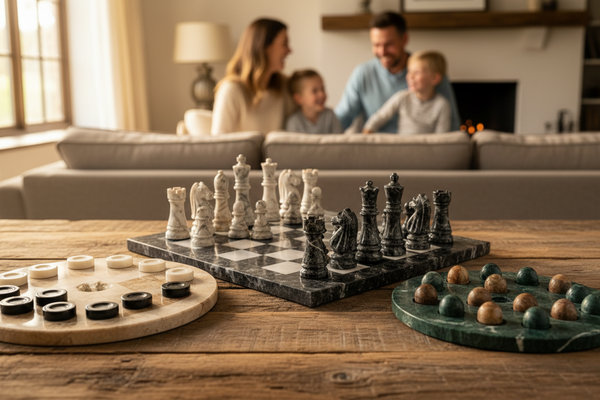
A handmade marble gift is genuinely unique — not in the marketing sense of the word, but in the literal sense. The specific piece your recipient receives exists nowhere else in the world. The veining in their chess board, the colour distribution in their mortar, the particular depth of green in their onyx pen holder — these are unrepeatable. That is the basis of an object that is, by definition, made for them.
Explore our full collection across seven categories, or visit the Gift Finder for occasion-based recommendations. Use code ARTREE10 for 10% off your first order — free shipping on all orders over $200.
Ready to bring this into your home? Explore Artreestry's full handcrafted marble collection.
Shop the Collection