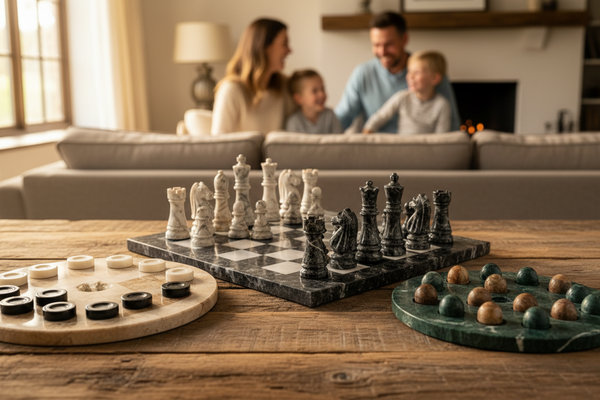
Most of what we own gets sorted, eventually, into two piles: things that get sold or donated, and things that get kept in the family. Marble pieces — chess sets, sculptural bowls, a hand-carved urn that sat on the same console table for twenty years — usually land in the second pile by default, simply because no one wants to be the one who let it go. But being kept isn't the same as being documented, and undocumented objects lose meaning faster than people expect.
Why Undocumented Objects Lose Meaning — and Value — Across Generations
Ask anyone who's cleared out a parent's or grandparent's home: the hardest part usually isn't the big furniture. It's the smaller, harder-to-place objects — the ones that clearly mattered to someone, but no one left behind an explanation of why. Without a record, a considered piece becomes an unlabeled one. It gets kept out of guilt rather than intention, or worse, it gets sold at a fraction of its worth because no one remaining can speak to its origin, material, or story.
This isn't really about money, although documentation does support fair valuation later. It's about making sure the piece keeps its meaning once you're no longer the one who can explain it.
Three Records Worth Keeping Per Piece
You don't need a formal archive. Three simple things, kept together, do most of the work:
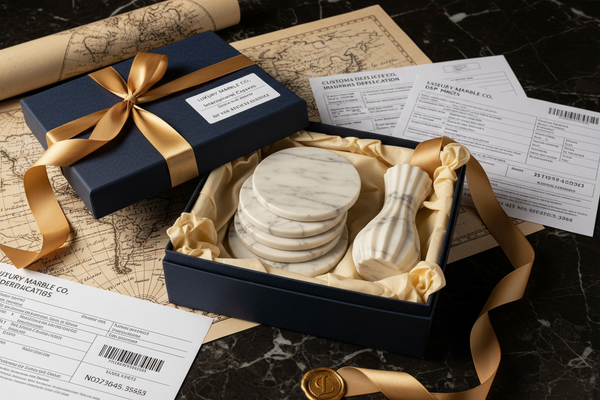
- Purchase documentation — the invoice or receipt, including the date, the material, and what you paid. This anchors both authenticity and value.
- Condition at acquisition — a few photographs taken when the piece was new to you, so any future question about damage or wear has a clear baseline.
- The story behind why you chose it — this is the record people skip, and it's the one that actually carries meaning forward. A single paragraph is enough: where you were, why this piece, what it replaced or commemorated.
Photographing a Collection Properly
For insurance purposes, a quick phone photo is usually enough. For a piece you intend to pass down, it's worth doing slightly better: neutral background, a few angles, and one close-up of any distinctive veining or coloring that makes the piece identifiable as itself rather than "a marble chess set" among several. Natural stone doesn't repeat — no two pieces carry identical veining — so a clear photograph is also a quiet form of authentication down the line.
Writing the Story Down
The object survives on its own. The reason you chose it doesn't — unless someone writes it down.
This is the step almost everyone intends to do and almost no one actually does. A short note — stored with the purchase documentation, or even taped inside a storage box — turns an inherited object into an inherited story. It doesn't need to be sentimental. "Bought this the year we moved into the house on Elm Street, from a small marble workshop, because your grandmother loved the green veining" is a complete, sufficient record.
What This Looks Like With an Artreestry Piece
Every order comes with an invoice documenting the stone variety, dimensions, weight, and SKU — a factual baseline you can build the rest of the record around. Keep it with whatever else you're setting aside for the pieces that matter, alongside your own photographs and your own note about why this particular piece, in this particular stone, earned a place in your home.
Looking for a piece worth documenting from day one? Explore Home Décor or see the full Marble Color & Stone Guide to choose a variety with a story attached before you even buy it.