At some point after a marble piece arrives — usually when you're describing it to a friend, or filling out a home inventory for insurance renewal — the question comes up: is this actually covered if something happens to it?
Most people assume the answer is yes, because it's just sitting in their home like everything else they own. The honest answer is: probably not fully, and it's worth five minutes to find out for certain rather than assume.
What Your Standard Policy Actually Covers
Homeowner's and renter's insurance policies typically bundle everything you own into a single category called unscheduled personal property, with an overall cap and, more importantly, a per-item sublimit that's easy to miss. Fine art, jewelry, collectibles, and — depending on the insurer — natural stone objects often fall under a much lower sublimit than the policy's headline coverage number suggests. A $2,000 sublimit on a policy that otherwise covers $300,000 in contents is common, and it applies per category, not per item.
This isn't a flaw specific to marble. It's how contents insurance works for anything that isn't furniture or electronics. The piece itself isn't the problem — the assumption that "my policy covers my house" automatically extends to every object at full replacement value is the actual gap.
When a Piece (or a Collection) Crosses the Line
There's no universal dollar threshold, because it depends on your policy's specific sublimit, not a fixed rule. But the practical trigger is simple: if you'd genuinely mind losing it and replacing it out of pocket, it's worth checking. A single 15-inch chess set is one thing. A collection — several sets, a few sculptural pieces, a vanity tray — adds up faster than people expect, because each one is evaluated against the same shared category cap.
The goal isn't to insure everything you own. It's to know, in advance, which pieces would actually need a phone call to your agent before you're standing in a pile of broken marble asking what happens now.
What You Actually Need for an Appraisal or Rider
Scheduling an item — adding it to your policy individually, at its own agreed value — is usually simpler than people expect. Most insurers ask for some combination of:
- Proof of purchase (an invoice or receipt showing what you paid and when)
- A clear description of the item — material, dimensions, and distinguishing characteristics
- Photographs from a few angles, including any natural veining or markings that make the piece identifiable
- For higher-value pieces, sometimes a third-party appraisal establishing current replacement value rather than original purchase price
Replacement value and purchase price aren't always the same number, particularly for handcrafted natural stone where a comparable piece may no longer be available in the exact same stone lot or color combination.
What This Looks Like With an Artreestry Piece
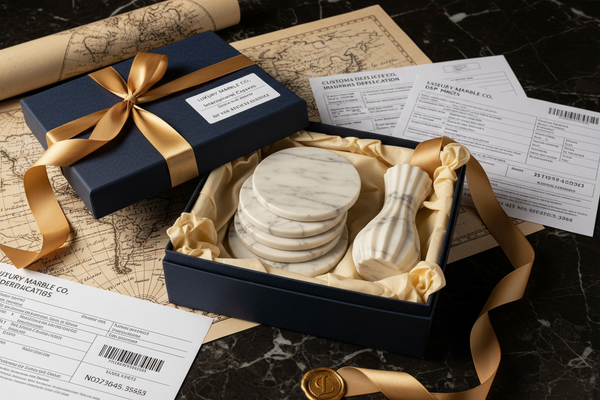
Every order includes an itemized invoice with the material, dimensions, weight, and SKU already documented — the same information an insurer typically asks for when scheduling an item. Keep that invoice with your other insurance paperwork rather than letting it disappear into an inbox. If you ever need to reference the exact stone variety or dimensions of a piece for a claim or an appraisal, that record is the fastest way to get it.
A Practical Checklist Before You Call Your Agent
- Pull together invoices for any individual pieces or collections worth more than a casual replacement
- Photograph each piece clearly, ideally with something for scale in frame
- Ask your agent directly what your current per-category sublimit is — most people have never asked
- Decide whether scheduling individual pieces or increasing a blanket category limit makes more sense for how you've bought over time
None of this is a reason to hesitate before buying a piece you love. It's simply the version of that conversation that happens on your terms, ahead of time, instead of during a claim.
Browse the full Board Games collection or see what's currently in the Best Sellers collection. Questions about documentation for a specific order? Get in touch — we keep full order records on file.